By Terri D. Goldson, Sr.
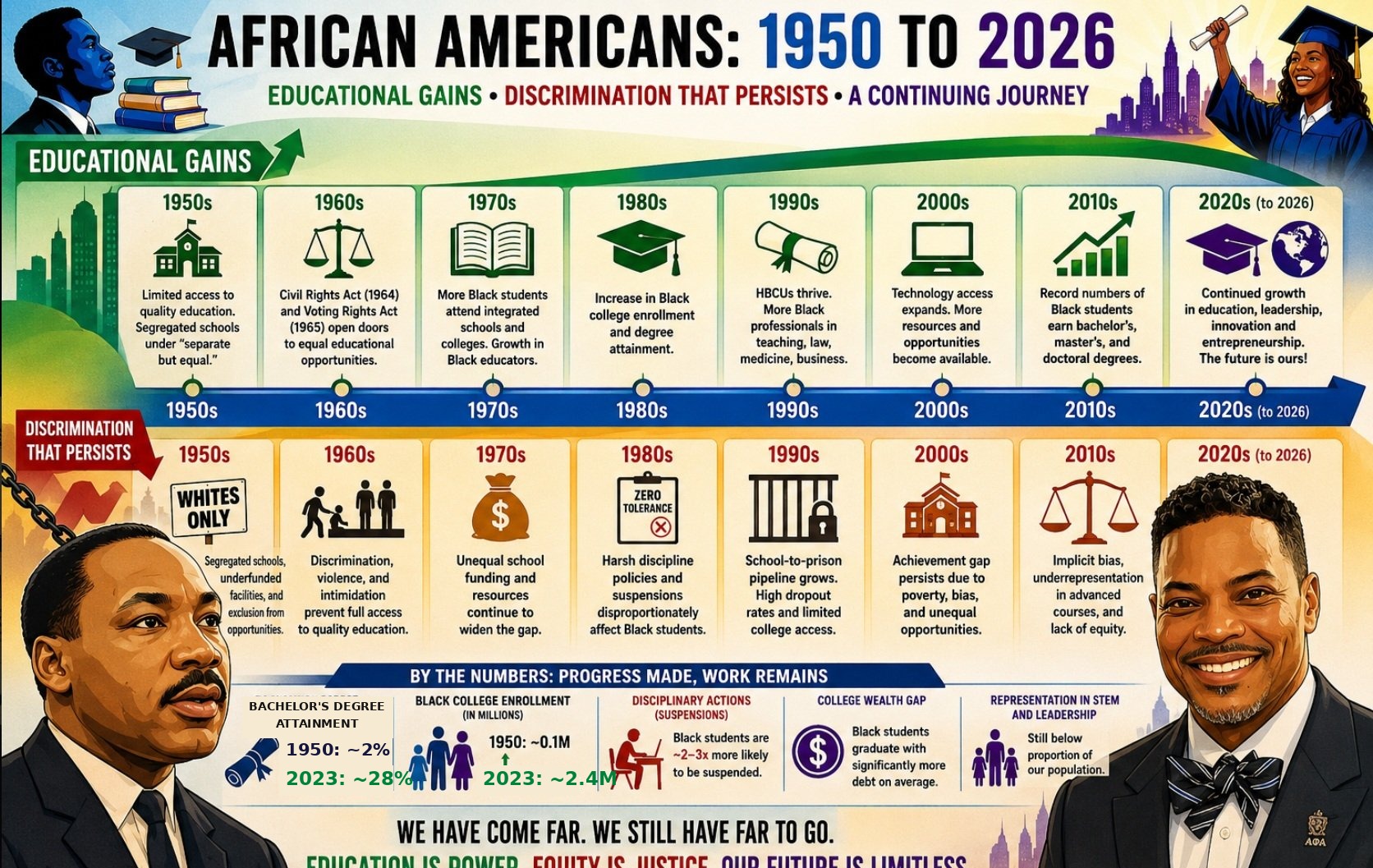
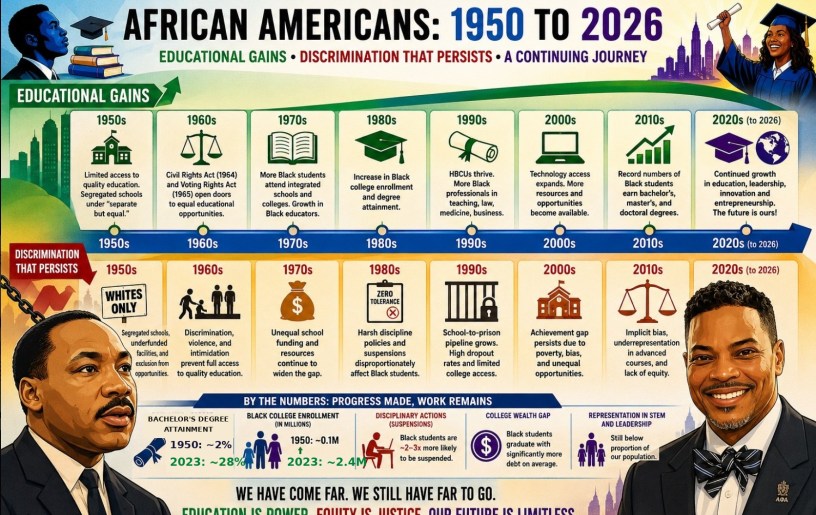
In 1950, many Black children attended segregated schools that were underfunded and under-resourced. Education was a promise made on paper and denied in practice. Over the next seven decades, Black Americans reshaped what was possible.
The Civil Rights Act and Voting Rights Act opened doors in the 1960s. Integration in the 1970s and rising college enrollment in the 1980s followed. HBCUs kept producing the teachers, lawyers, doctors, and business leaders who lifted whole communities in the 1990s. Technology expanded access in the 2000s. By the 2010s, Black students were earning bachelor’s, master’s, and doctoral degrees in record numbers.
By the Numbers — corrected against Census and NCES:
- High school completion, Black adults age 25 and older: about 7.7% in 1940, about 88% by 2020. (Census)
- Bachelor’s degree or higher, Black adults age 25 and older: 2.2% in 1950 (1.3% in 1940), 27.6% in 2022. (NCES Table 104.10; Census / Journal of Blacks in Higher Education)
- Black college enrollment, fall 2023: about 2.4 million students in degree-granting institutions. (NCES Table 306.20)
But progress has never meant arrival. Each decade also carried barriers: segregation, intimidation, unequal school funding, harsh “zero tolerance” discipline, the school-to-prison pipeline, and persistent achievement gaps rooted in poverty and unequal opportunity. Today the barriers are subtler but real: implicit bias, underrepresentation in advanced courses, and a lack of equity in how students are taught, disciplined, and supported. In 2022, 27.6% of Black adults held at least a bachelor’s degree, compared with 48.2% of non-Hispanic whites, as reported by the Journal of Blacks in Higher Education from Census data.
Both stories are true, and both belong in the same picture. The gains were won by families, educators, and communities who refused to accept less. The gaps remain because opportunity is still not evenly distributed.
Education is power. Equity is justice. The future is limitless, but only if we keep building it.
Sources checked November 7, 2026:
- U.S. Census Bureau, “88% of Blacks Have a High School Diploma, 26% a Bachelor’s Degree” (June 10, 2020) — 7% Black high school in 1940, 88% today; 1% Black college completion in 1940, 26% in 2019.
- U.S. Census Bureau, Educational Attainment in the United States: 2022 (Feb. 16, 2023) — Black bachelor’s or more rose from 21.2% in 2012 to 27.6% in 2022.
- Journal of Blacks in Higher Education, “The Persistent Racial Gap in Educational Attainment in the United States” (Feb. 27, 2023) — 27.6% Black, 48.2% non-Hispanic White in 2022.
- NCES Table 104.10 — Black bachelor’s or higher, age 25+: 1.3% in 1940, 2.2% in 1950.
- NCES Table 306.20 — Total fall enrollment, Black students, degree-granting institutions, fall 2023: 2,412,200 (about 2.4 million).

